General information, not legal advice.
Software licence agreements frequently give the vendor a right to verify that its products are being used within the agreed terms. When a vendor — or an organisation acting for it — invokes that right, the request can feel like a significant call on your team's time. It does not have to be. A short period of preparation before you respond makes the process faster, more accurate and less disruptive for everyone involved.
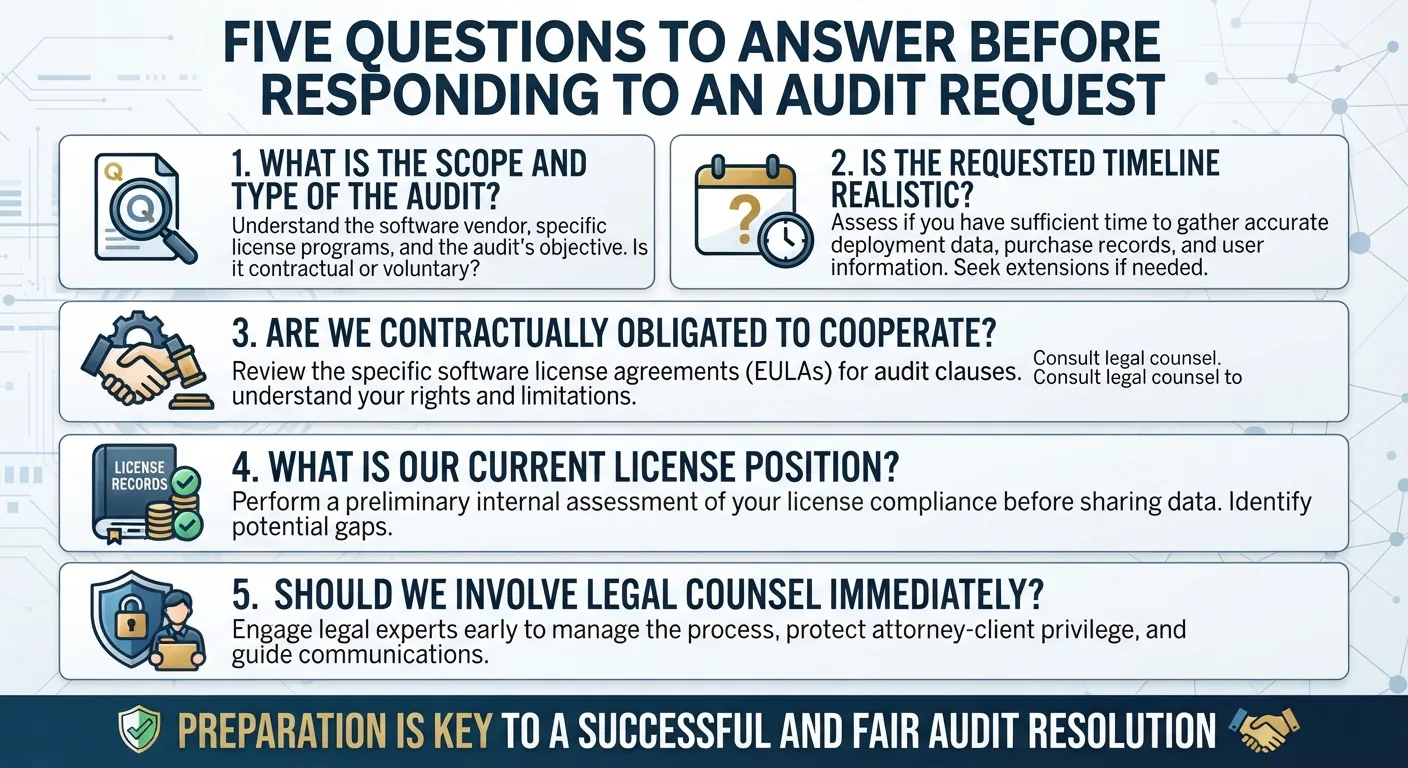
Here are five questions we recommend answering before you send any substantive reply.
1. What does our agreement actually say about audits?
Start with the contract. Most enterprise licence agreements contain a clause that sets out whether the vendor may audit, how much notice it must give, how often audits may take place, who may carry them out, and who bears the cost.
Look in particular for:
- Notice periods — for example, 30 days' written notice before an audit begins;
- Frequency limits — often no more than once in any twelve-month period;
- Scope — which products, entities and locations are covered;
- Method — whether the audit is a self-declaration, a remote review using scripts or tools, or an on-site visit;
- Confidentiality — how the information you provide may be used and shared.
If you cannot find the agreement, ask your reseller or the vendor for a copy. Knowing the agreed rules lets you respond on a firm footing and keep the audit within its proper limits.
2. Which entities, sites and systems are in scope?
Group structures can complicate audits. A licence may have been bought by one company in a group but used by another, or software may be installed in a data centre that serves several subsidiaries.
Map out which legal entities, locations and environments the request covers, and whether your licences allow use by affiliates, contractors or outsourcing partners. Clarifying scope at the outset avoids collecting data you do not need to provide and prevents misunderstandings later.
3. What do we own, and can we prove it?
Assemble your proof of entitlement: invoices, licence certificates, order confirmations, subscription records and any agreements with resellers. Check that the records match the product names, editions and versions in use — licensing terms can differ significantly between editions of the same product.
Pay attention to:
- licences bought through a reseller or bundled with hardware;
- licences transferred as part of an acquisition or reorganisation;
- subscriptions that have lapsed but whose software is still installed;
- free or trial editions whose terms do not permit commercial use.
Where records are incomplete, note the gaps honestly. It is better to identify them yourself than to have them discovered later.
4. What is actually deployed and in use?
The second half of the picture is deployment. Gather data on installations, users and — for server software — the hardware or virtual environments involved, since many licence models count processors, cores or virtual machines rather than people.
Bear in mind that "installed" and "in use" are not always the same, and that the relevant measure depends on the licence model. Virtualisation, disaster-recovery environments and test systems often raise specific questions; check how your agreement treats them.
If you use a software asset management tool, export its data, but verify a sample manually. Automated discovery tools are useful but not infallible.
5. Who will manage the process?
Finally, decide who is responsible. A single point of contact keeps communication consistent and avoids conflicting information being sent by different teams. Typically this person coordinates input from IT, procurement and finance, and involves legal advisers where the agreement or the findings raise questions.
Agree internally:
- who will correspond with the auditor;
- who approves any data before it is shared;
- how information will be transferred securely;
- what timeline is realistic, so you can propose one if the requested deadline is too short.
Responding
With these answers in hand, you are in a good position to reply. A constructive first response typically acknowledges the request, confirms your point of contact, clarifies scope where necessary and proposes a practical timeline. If anything in the request appears to go beyond what the agreement allows, say so politely and explain why.
An audit conducted in this way is usually a matter of reconciliation: comparing what has been bought with what is in use, and agreeing how to close any gap. Where a gap is found, the typical outcome is the purchase of the licences needed — and a clearer picture of your software estate for the future.
If you have questions about a request you have received from us, please contact our case team, quoting your reference number. Our guide for recipients explains how.